A CREATIVE JOURNEY FOR AGES 9 & ABOVE
From a few dots an entire world of patterns can appear.
What if you could learn to see the logic hidden inside one of India's most beautiful everyday traditions?
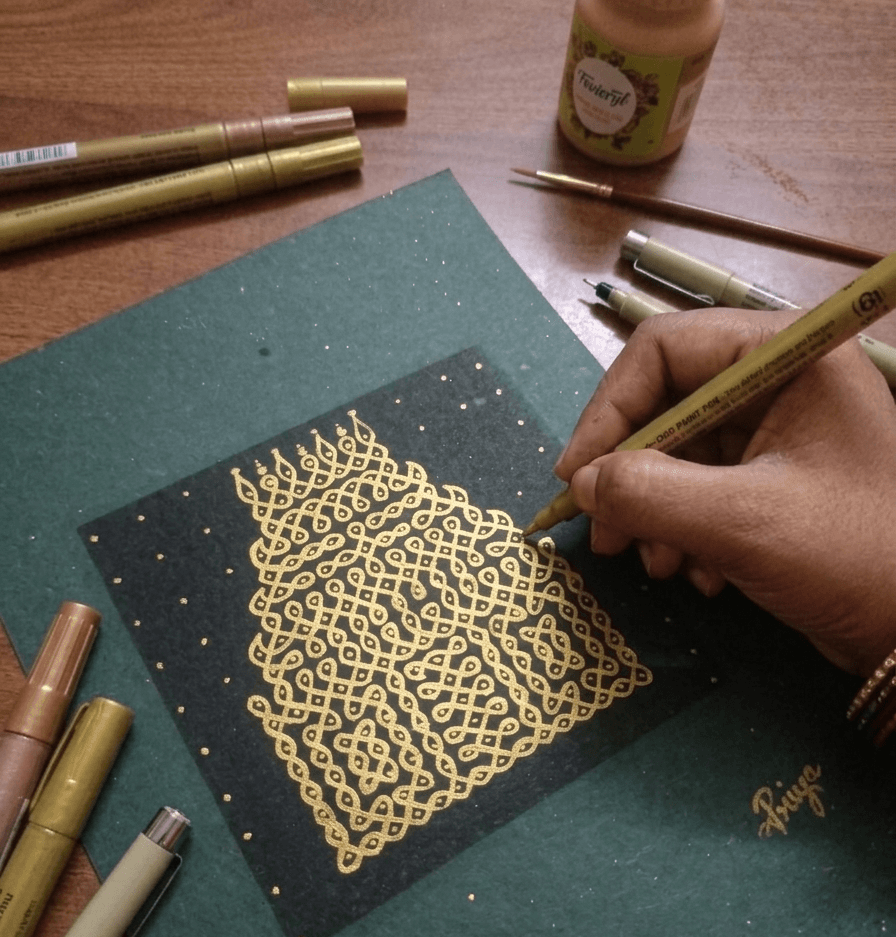
Kōlam: The Art Between The Dots course is a six-week creative journey where children and adults learn Sikku Kōlam, beginning with simple dots and gradually discovering loops, patterns, symmetry, rhythm and increasingly intricate designs.
Kōlam is not simply something we draw. It is something we learn to see.
Ages 9 and Above
6 WEEKS of Online Sessions
Beginner Friendly
SCROLL
↓
LOOK CLOSER
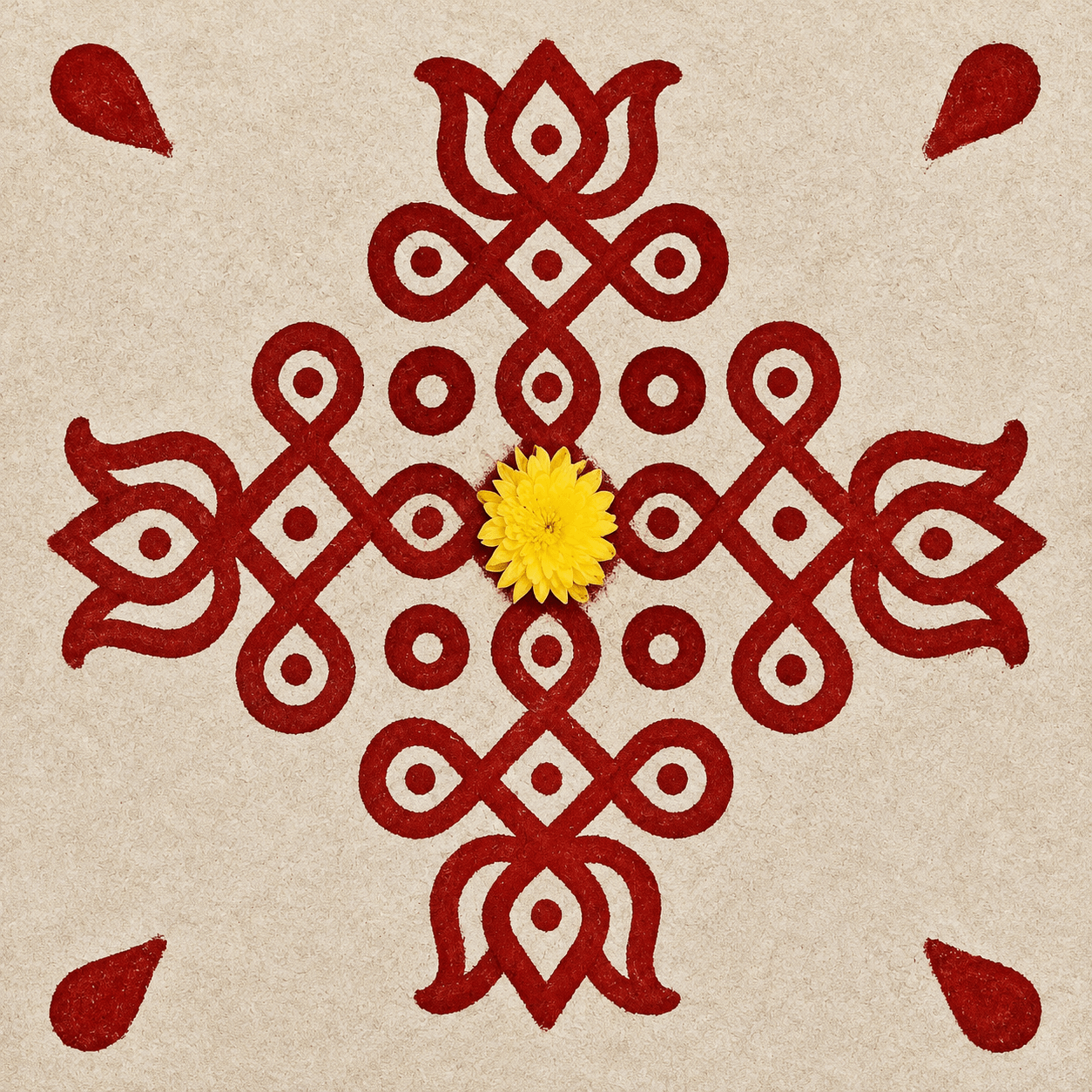
A line can teach you to look differently.
At first, a Kōlam may look wonderfully complicated.
But look closer.
There are dots.
There is repetition.
There is rhythm.
There is balance.
And there is a line finding its way through all of them.
Over six weeks, you will learn to slowly decode this visual language. You won't simply copy Kōlams.
You learn how Kōlams work.
And as your hands become more confident, your eyes begin noticing patterns everywhere: In flowers, leaves, fabrics, tiles, architecture and the world around you.
Can you see what is hiding inside?
A Kōlam may look intricate at first. But look closely, and a quiet visual language begins to appear.
It begins with a grid.
Before there are loops, curves or intricate patterns, there are simply dots — puḷḷi — placed with care.
Children don't just learn to copy a Kōlam.
They begin to understand how it works.
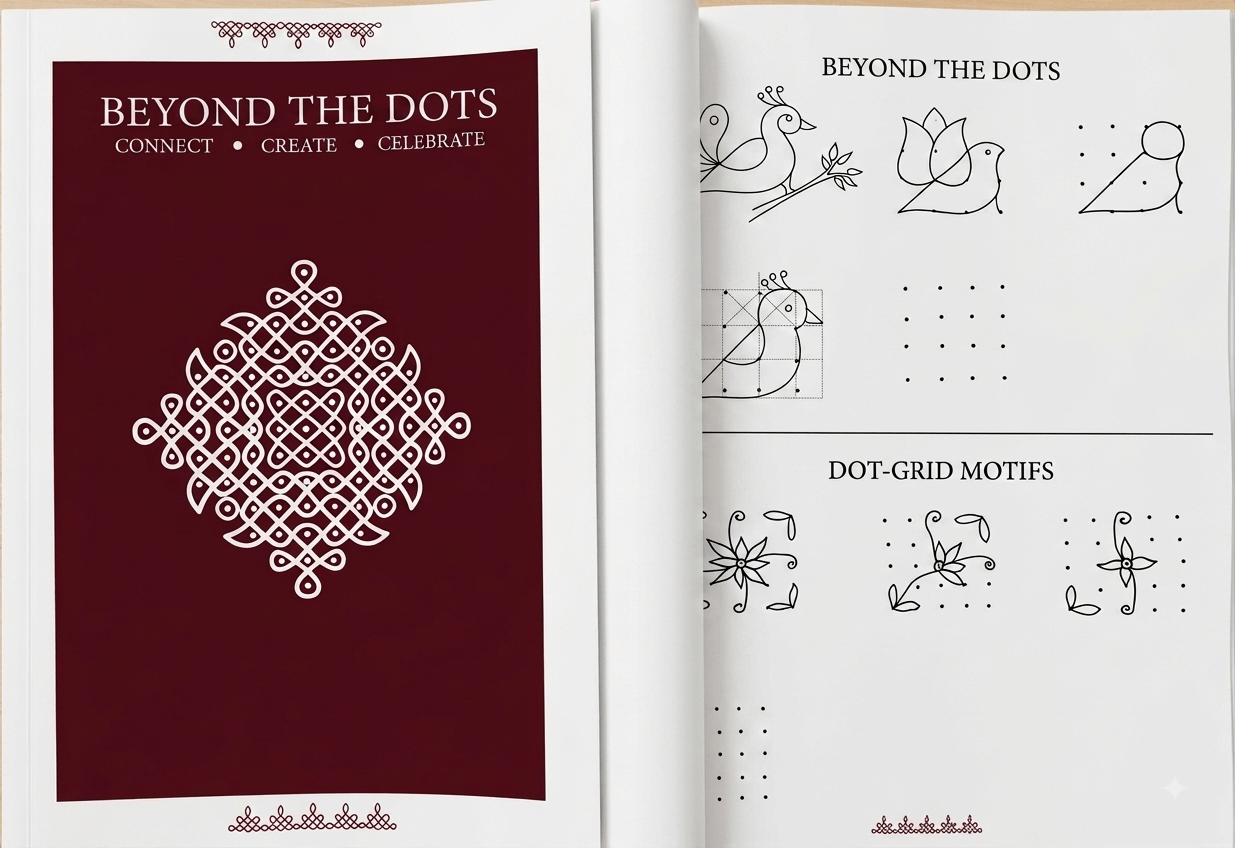
Come for the art. Leave seeing patterns everywhere.
1. Draw
Create Sikku Kōlams independently with growing confidence.
2. Discover
Recognise pattern, repetition, symmetry, and visual rhythm.
3. Connect
Understand Kōlam as a living Indian tradition connected to everyday life.
4. Observe
Notice patterns more carefully in nature, architecture, textiles and their surroundings.
5. Slow-down
Experience the quiet concentration that comes from guiding one continuous line around a field of dots.
Practice, not perfection, sits at the heart of the journey.
One dot. Six weeks.
A whole new way of seeing.
Each week, the dots become a little more intricate — and you begin to see a little more.
You begin by following a line. Soon, you begin recognising the pattern behind it.
Begin with a Dot
Discover what Kōlam is, explore its different forms, and draw your first Sikku Kōlams using a simple 3 × 3 puḷḷi grid.
You begin by following the dots, noticing how a line curves around them and slowly becomes a pattern.
Find the Pattern
Move into 5 × 5 grids and begin noticing how repetition allows a Kōlam to grow.
Instead of simply copying where the next line goes, you begin recognising movements that repeat. Little by little, the Kōlam starts making sense.
Find the Balance
Why does a Kōlam feel balanced even when every line has not been measured?
As you draw increasingly detailed patterns, you begin noticing how one curve responds to another, how shapes repeat, and how the whole design finds its balance.
Meet a Living Tradition
Why are Kōlams drawn outside homes? Why do they become more elaborate during certain festivals? Why might the Kōlam you see in one family look different from another?
This week, you step beyond the pattern itself and explore the place Kōlam holds in everyday life, celebrations, homes and communities. You begin to see Kōlam not only as an art form, but as a tradition that continues to live because people continue to practise it.
Find Your Rhythm
Now your Kōlams become more intricate as you progress towards 7 × 7 and 9 × 9 grids.
Something else may begin to change too. Your hand slows down. Your attention settles. The curves begin to feel more familiar. Instead of thinking about every individual movement, you begin experiencing the rhythm of the whole pattern.
Make It Yours
For your final challenge, bring together everything you have discovered over the six weeks and complete a larger Sikku Kōlam.
The dots are more numerous. The pattern is richer. But now, you know how to look. You know how to find repetition. You know how to follow the rhythm of the line. And most importantly, you know how to begin again when something doesn't quite work.
You began by seeing dots. Now, you begin to see what can emerge between them.
Where will your next Kōlam begin?
This isn't the end of learning Kōlam. It is the point where you begin exploring it for yourself.
The Learning Continues
Beyond the Dots
The class may end. The noticing doesn't.
Every week, you receive a tiny invitation to carry the learning into your everyday life.
Not homework.
A noticing challenge.
Notice how the veins branch and repeat.
Notice the weave — a pattern within a pattern.
Spot the pattern hidden in the ironwork.
Study the design, repeated again and again.
Look closely — petals repeating around a centre.
Notice the rhythm in columns and arches.
See. Notice. Wonder. Draw.
Because the hand can teach the mind.
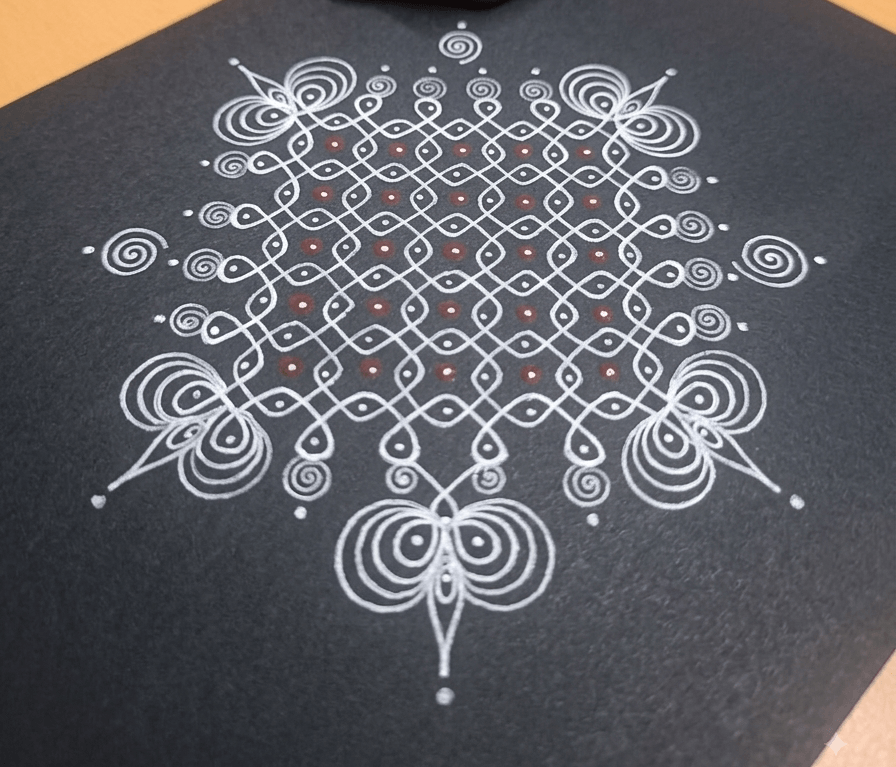
You encounter plenty of activities that ask you to finish something. Kōlam asks you to stay with something.
A dot asks for attention.
A curve asks for control.
A repeating pattern asks for observation.
A continuous line asks you to remember where you have been and notice where you are going.
And an imperfect Kōlam quietly teaches:
Try again.
There is no race to finish. No perfectly straight line to chase. Just observation, practice and the delight of watching something beautiful emerge from your own hand.
Guided by someone who sees heritage everywhere.
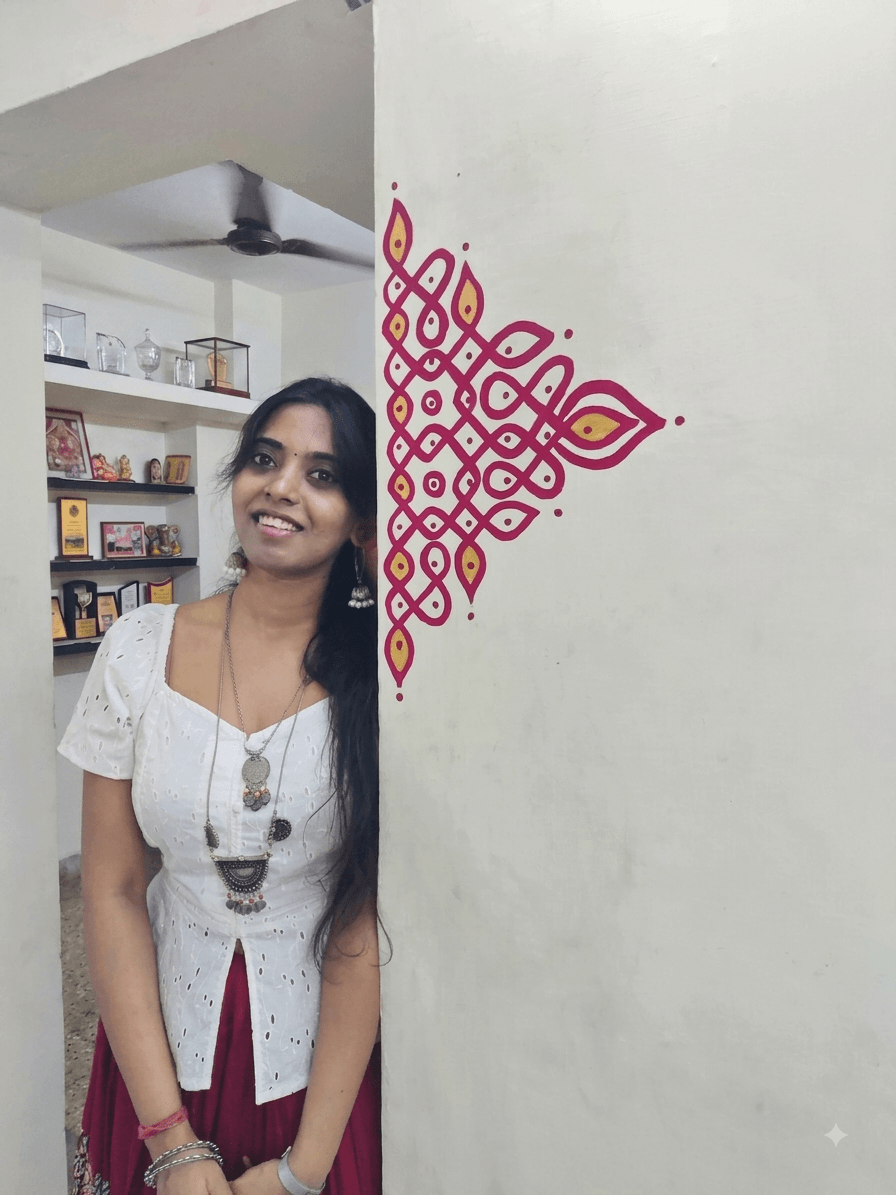
Priya Ramakrishnan
Architect & Conservation Architect
For Priya, heritage doesn't live only inside monuments. It lives in the things people continue to do. Her work in architecture and conservation has trained her to look closely at spaces, proportions, patterns and the stories embedded within them.
Kōlam brings many of these worlds together: design, observation, culture, creativity and everyday practice. Through this programme, Priya invites children and adults not simply to reproduce beautiful Kōlams, but to become curious about how they work, what they carry, and why they continue to matter.
How you learn
No lectures. No pressure to get it perfect.
Each session follows a simple rhythm. You arrive, discover an idea, explore it with your hands, and carry a little of what you noticed into the week ahead.
- 01
Arrive
Settle before you begin.
Take a few quiet moments to arrive. Slow down. Notice your breath. Leave behind the rush of whatever came before. Before your hand begins to draw, you give your attention a moment to settle.
- 02
Discover
Look before you draw.
Every session begins with an idea, question or observation. You might explore repetition. Notice symmetry. Look at a tradition. Or wonder why a particular pattern works the way it does. You begin with curiosity rather than instructions.
- 03
Draw
Let your hand understand.
Now you begin drawing. One dot. One curve. One movement at a time. You follow, repeat, experiment and gradually recognise how the pattern comes together. There is no need to make every line perfect. The understanding grows through practice.
- 04
Notice
Carry it beyond the page.
Before you leave, pause and look again. What became easier? What did you begin to notice? What would you like to try again? Then carry one small observation into your week — perhaps a pattern in a flower, a window, a textile or a space you pass every day.
Arrive. Discover. Draw. Notice.
Each week, the rhythm remains familiar. What you begin to see within it keeps changing.
You don't have to get the Kōlam perfect.
You simply have to stay with the line.
Every Kōlam begins with a dot.
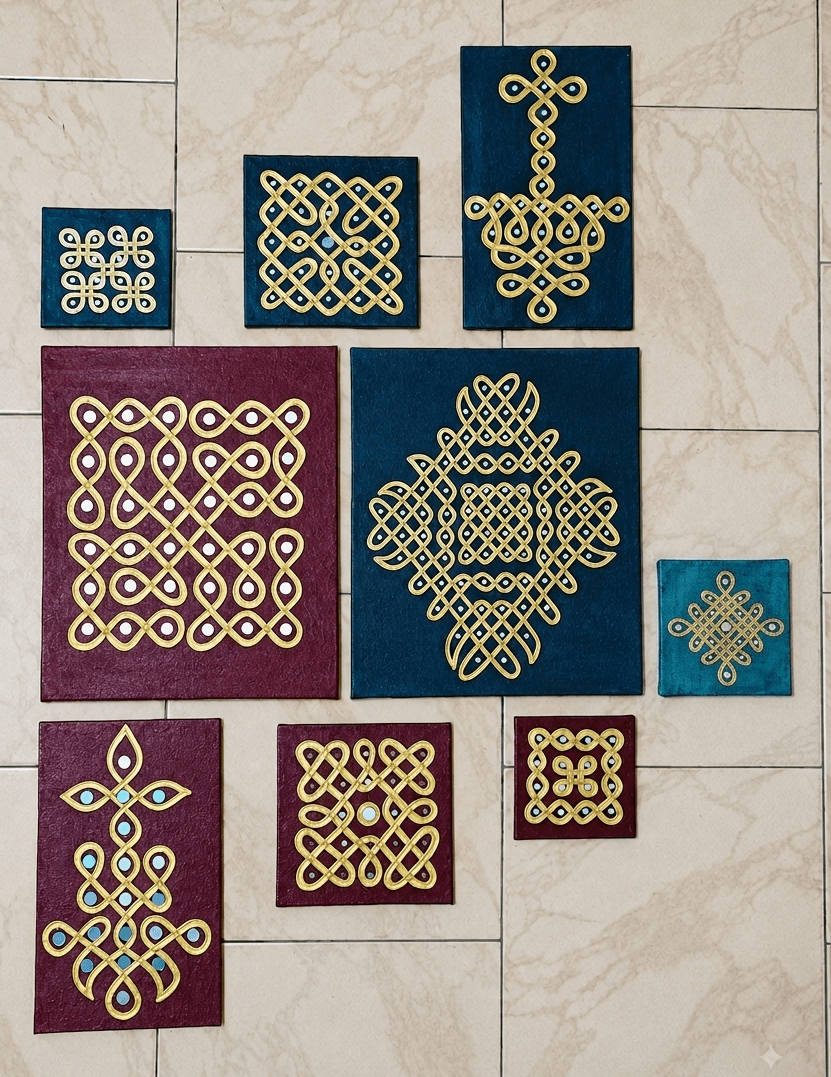
Every tradition continues because someone chooses to uphold it.
The Kōlam traditions continues by simply drawing it.
Perhaps the next Kōlam will be yours.
Vyūha Learning Labs
Kōlam: The Art Between The Dots